
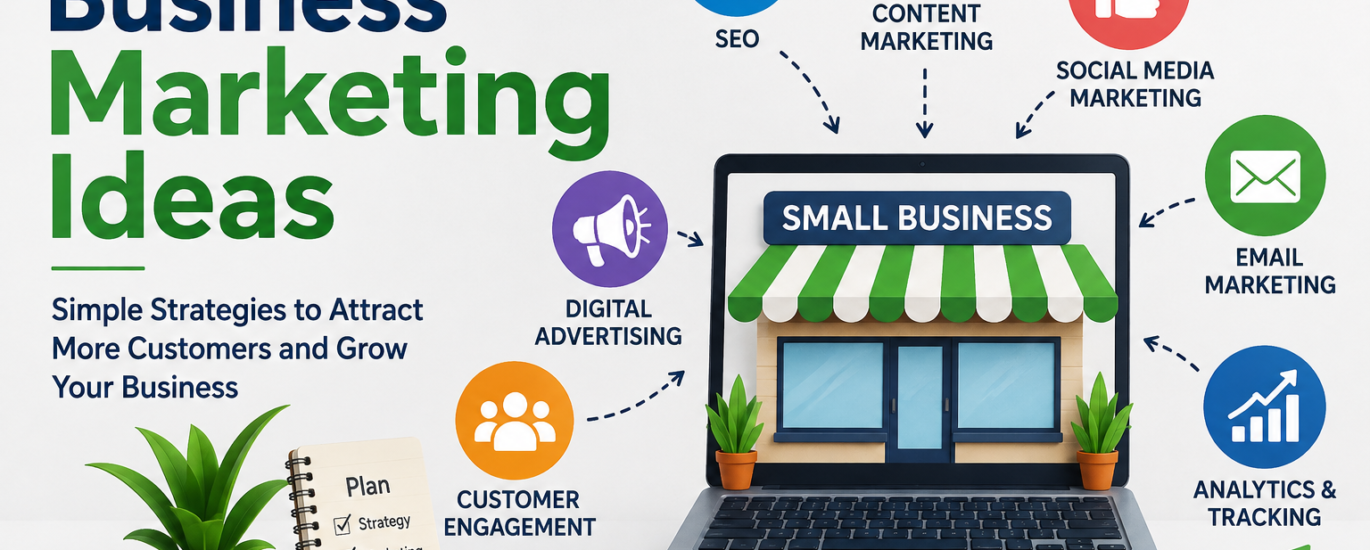
Finding effective smFinding effective small business marketing ideas can be challenging when you have a limited budget, a small team, and strong competition. The good news Finding effective small business marketing ideas can be challenging when you have a limited budget, a small team, and strong competition. The good news is that you do not need a large marketing budget to attract customers, increase visibility, and grow your business. With the right strategy, consistent effort, and effective digital channels, a small business can build a strong online presence and compete with larger businesses.
15 Best Small Business Marketing Ideas to Grow Your Business
Finding effective small business marketing ideas can be challenging when you have a limited budget, a small team, and strong competition. The good news is that you do not need a large marketing budget to attract customers, increase visibility, and grow your business. With the right strategy, consistent effort, and effective digital channels, a small business can build a strong online presence and compete with larger businesses.
Today, customers often search online before purchasing a product or service. They may check Google, read reviews, visit a website, compare businesses, and look at social media before making a decision. This makes digital marketing an important part of modern business growth.
The most effective approach is to understand your target audience, choose the right platforms, create useful content, and track your results. In this guide, you will discover practical small business marketing ideas that can help you attract customers, generate leads, build trust, and increase sales.
You can also explore our guide on Small Business Marketing Ideas to Boost Online Growth for more practical strategies.
Why Marketing Is Important for Small Businesses
Marketing helps potential customers discover your business and understand why they should choose your products or services.
Even if you provide excellent products or services, people cannot become customers if they do not know your business exists. A well-planned marketing strategy helps you communicate your value and reach the right audience.
A strong marketing strategy can help you:
- Increase brand awareness
- Attract new customers
- Generate qualified leads
- Improve online visibility
- Increase website traffic
- Build customer trust
- Generate more sales
- Develop long-term customer relationships
For small businesses, marketing should focus on measurable business outcomes instead of simply collecting likes or followers. The right small business marketing ideas should support your actual business goals.
If you want to understand how different digital channels work together, read our guide on Digital Marketing Strategy Framework for Business Growth.
15 Best Small Business Marketing Ideas to Grow Your Business
There are many ways to promote a business online, but you do not need to use every marketing channel. Start with the strategies that are most relevant to your audience, industry, location, and business goals.
1. Create a Professional Business Website
A professional website should be one of the first priorities for any business.
Your website acts as your digital home where potential customers can learn about your company, explore your services, read testimonials, and contact you.
Your website should include:
- A clear business description
- Service or product pages
- Easy-to-find contact information
- Strong call-to-action buttons
- Customer testimonials
- Frequently asked questions
- Mobile-friendly design
- Fast-loading pages
Your homepage should immediately communicate what you offer and who you serve.
A good website is more than an attractive online presence. It should guide visitors toward taking action, such as making a phone call, submitting a form, requesting a quote, or purchasing a product.
For businesses starting their online marketing journey, creating a professional website is one of the most practical small business marketing ideas because it provides a foundation for SEO, advertising, social media, and content marketing.
2. Optimize Your Google Business Profile
For local businesses, Google Business Profile is one of the most useful marketing tools available.
When customers search for businesses or services nearby, a properly optimized profile can help your business appear in local search results.
Make sure your profile contains accurate:
- Business name
- Address
- Phone number
- Website
- Business category
- Opening hours
- Services
- Photos
- Business description
You can learn more about setting up and managing your profile through the official Google Business Profile Help.
Encourage satisfied customers to leave genuine reviews and respond professionally to customer feedback.
This strategy can be particularly useful for restaurants, agencies, salons, educational businesses, repair companies, consultants, and other local service providers.
3. Focus on Local SEO
Local SEO helps your business become more visible when people search for products or services in a specific location.
For example, a digital marketing company might target searches such as:
- Digital marketing agency in Siwan
- SEO agency near me
- Social media marketing agency in Bihar
- Google Ads agency in Siwan
Create useful location-based pages when they genuinely provide value to visitors.
You should also maintain consistent business information across relevant online directories and platforms.
For additional information about improving your website’s search visibility, you can refer to Google Search Central.
Local SEO is one of the most effective small business marketing ideas for businesses that depend on customers from a specific city, area, or region. It can provide long-term benefits because it helps you reach customers who are already looking for your products or services.
If you are new to SEO, you can also read our guide on Best SEO Tool for Beginners: Easy Guide to Get Started to learn about useful tools for improving website performance.
4. Start Content Marketing
Creating helpful content is another cost-effective way to attract potential customers.
Instead of publishing promotional posts all the time, create content that answers questions your target audience is searching for.
For example, a website design company could publish articles about:
- How to create a business website
- Common website design mistakes
- Website cost for small businesses
- Benefits of having a professional website
- Ways to improve website conversions
Useful content can attract visitors from search engines and establish your business as a reliable source of information.
Content can also be reused across social media, email newsletters, and other marketing channels. This makes content marketing a valuable option for businesses looking for affordable small business marketing ideas.
For a complete roadmap, you can also explore The Complete Guide: How to Learn Digital Marketing in 2026.
5. Use Social Media Marketing
Social media gives small businesses an opportunity to connect directly with customers.
Instead of trying to maintain every social media account, identify where your target audience spends the most time.
Depending on your business, you may use:
- YouTube
Create content that provides value instead of only promoting your products.
You can share:
- Educational tips
- Product demonstrations
- Customer stories
- Behind-the-scenes content
- Frequently asked questions
- Short videos
- Industry updates
Consistency is more important than posting a large number of times every day.
A focused social media strategy can be one of the easiest small business marketing ideas to start with, especially when you have limited resources.
6. Collect Genuine Customer Reviews
Reviews can have a major influence on purchasing decisions.
Before contacting a business, potential customers often want to know what previous customers experienced.
Ask satisfied customers to leave genuine reviews on relevant platforms.
You can also display genuine testimonials on your website.
When you receive negative feedback, respond professionally and try to understand the customer’s concern. A thoughtful response can demonstrate that your business takes customer satisfaction seriously.
Avoid purchasing fake reviews. Authentic feedback is much more valuable for building long-term trust.
7. Build an Email Marketing List
Email marketing allows you to communicate directly with people who have shown interest in your business.
You can encourage website visitors to subscribe by offering something useful, such as:
- A free guide
- Checklist
- Discount
- Consultation
- Newsletter
- Industry tips
After building your email list, send useful and relevant information.
Your emails can include educational content, business updates, special offers, new products, and helpful resources.
The goal should be to build a relationship with subscribers instead of sending promotional messages constantly.
8. Create Short-Form Video Content
Video is an increasingly useful format for reaching potential customers.
You do not need expensive equipment to start. A smartphone, good lighting, and a clear message can be enough.
Create short videos around common customer questions.
For example:
- Quick marketing tips
- Product tutorials
- Frequently asked questions
- Behind-the-scenes videos
- Common mistakes
- Industry advice
- Customer success stories
Short videos can be shared across platforms such as Instagram, Facebook, and YouTube.
Focus on solving a problem or answering a question rather than making every video a sales pitch.
9. Run Targeted Google Ads
Paid advertising can help businesses reach potential customers faster.
Google Ads can be especially useful when people are actively searching for products or services.
For example, a local company can create campaigns targeting keywords related to its services and location.
You can learn more about advertising options through Google Ads.
Before starting a campaign, determine:
- Your target audience
- Campaign objective
- Daily budget
- Target keywords
- Landing page
- Conversion goal
Track meaningful actions such as calls, purchases, quote requests, or form submissions instead of focusing only on clicks.
Paid advertising can complement organic strategies and provide another option among effective small business marketing ideas when you have a defined budget and measurable conversion goals.
10. Experiment With Social Media Advertising
Facebook and Instagram advertising can help businesses reach specific audiences.
You can learn more about business advertising and marketing tools through Meta for Business.
Depending on the campaign and platform, you can target audiences based on location, interests, demographics, and other available criteria.
Social media advertising can be used for:
- Brand awareness
- Lead generation
- Website traffic
- Product promotion
- Retargeting
- Event promotion
Start with a manageable budget. Test different images, videos, headlines, and offers before increasing your spending.
Testing helps you understand what type of message works best for your audience.
11. Create a Referral Program
Your existing customers can become an important source of new business.
Create a simple referral system that encourages satisfied customers to recommend your business to friends, family, colleagues, or other businesses.
Depending on your business model, you can provide an appropriate incentive for successful referrals.
However, the foundation of referral marketing is customer satisfaction.
If customers receive excellent service and have a positive experience, they are more likely to recommend your business naturally.
12. Partner With Other Local Businesses
Collaboration can help small businesses reach new audiences.
Look for businesses that serve a similar target audience without directly competing with your company.
For example, a photographer could collaborate with:
- Event planners
- Wedding venues
- Makeup artists
- Clothing stores
- Caterers
Businesses can cross-promote each other’s services, create joint offers, or organize local events.
Partnership marketing can increase visibility while requiring less advertising expenditure. It is also a useful strategy for businesses searching for practical small business marketing ideas that do not depend entirely on paid advertising.
13. Improve Your Online Reputation
Your online reputation can influence whether potential customers decide to contact your business.
Search your business name online and review what potential customers see.
Check:
- Google reviews
- Social media profiles
- Business directories
- Website information
- Customer comments
- Search engine results
Make sure your contact information and business details are accurate and consistent.
A professional online reputation can increase customer confidence and support your other marketing activities.
14. Use SEO and Internal Linking
SEO can help your website attract organic traffic from search engines.
When publishing blog articles, use relevant keywords naturally and connect related pages through internal links.
For additional SEO guidance, you can refer to the official Google Search Central SEO documentation.
For example, if you are writing about small business marketing ideas, you can link readers to your detailed guide on Digital Marketing Strategy Framework for Business Growth.
You can also link to Best SEO Tool for Beginners when discussing SEO tools and optimization.
You can also read Small Business Marketing Ideas to Boost Online Growth for additional ideas and strategies.
Internal linking helps visitors discover related content and makes it easier for search engines to understand how different pages on your website are connected.
Use descriptive anchor text and make sure the linked article is genuinely relevant to the topic.
You can also connect your marketing articles with other relevant pages on your website, such as SEO, Google Ads, social media marketing, or digital marketing guides. This creates a stronger internal linking structure and improves the overall user experience.
15. Track Your Marketing Results
One of the most important small business marketing ideas is measuring your results.
Without tracking, you may spend time and money on strategies that are not producing meaningful business outcomes.
Important metrics can include:
- Website traffic
- Leads
- Phone calls
- Form submissions
- Sales
- Conversion rate
- Search rankings
- Social media engagement
- Cost per lead
- Advertising return
Tracking allows you to identify which strategies are working.
For example, if your blog content generates organic traffic and leads, you may want to create more content around similar topics.
If a paid campaign generates qualified leads at an acceptable cost, you can optimize the campaign and gradually increase the budget.
How to Choose the Right Marketing Strategy
Not every marketing channel works equally well for every business.
Before selecting your strategy, answer five important questions.
Who Are Your Customers?
Understand your ideal customer’s needs, problems, location, interests, and purchasing behavior.
Where Do They Search?
Some audiences primarily use Google, while others discover businesses through Instagram, YouTube, Facebook, or LinkedIn.
What Problem Do You Solve?
Your marketing message should clearly explain how your product or service helps customers.
What Is Your Budget?
Choose marketing activities that you can maintain consistently rather than spending your entire budget on a short campaign.
What Is Your Goal?
Your strategy should depend on whether you want more brand awareness, website traffic, leads, phone calls, or sales.
Low-Budget Small Business Marketing Ideas
If you have a limited budget, focus on strategies that can generate long-term value.
Some affordable options include:
- Google Business Profile optimization
- Local SEO
- Blogging
- Social media content
- Email marketing
- Customer referrals
- Online reviews
- Short-form videos
- Local networking
- Internal linking
You do not have to implement everything at once.
Choose two or three strategies, execute them consistently, and measure their performance.
Once you understand what works, gradually expand your marketing activities.
For example, you could begin with a professional website, Google Business Profile optimization, and content marketing. After building a strong foundation, you can add paid advertising and email marketing.
Common Marketing Mistakes Small Businesses Should Avoid
Many businesses make simple mistakes that can reduce the effectiveness of their marketing.
Avoid:
- Trying to target everyone
- Posting without a strategy
- Ignoring local SEO
- Buying fake followers
- Purchasing fake reviews
- Running ads without conversion tracking
- Using outdated website information
- Publishing low-quality content
- Focusing only on likes
- Changing strategies too frequently
Marketing requires patience and consistency.
Give a strategy enough time to collect useful data before deciding whether it should be changed.
Conclusion
The best small business marketing ideas are not always the most expensive strategies. Effective marketing comes from understanding your audience, selecting the right channels, creating valuable content, building trust, and measuring your results.
Start with a strong foundation. Build a professional website, optimize your Google Business Profile, improve local SEO, create useful content, use social media, collect genuine reviews, and build relationships with customers.
Once these foundations are working, you can expand into email marketing, video marketing, Google Ads, social media advertising, referral campaigns, and other strategies.
The key is to start small, remain consistent, track your performance, and improve your strategy based on real results. With the right approach, these small business marketing ideas can help a small business increase its online visibility, attract qualified customers, generate leads, and achieve sustainable growth.